


Thermo-gravimetric analysis
TGA4000 (Perkin Elmer)
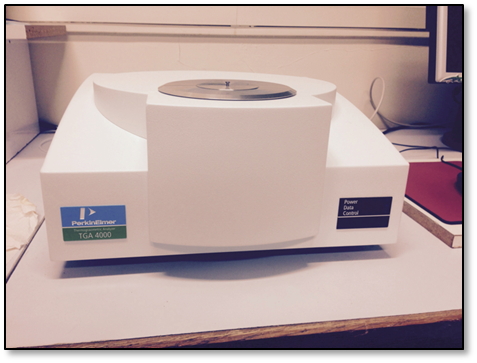
Device:
The thermogravimetric analyzer TGA 4000 consist of a micro-balance coupled to an oven, which allows to follow the variation of a sample weight during eating-induced transformations.
- Temperatures range: 30°C – 1000°C
- Sample weight: 5 mg to 200 mg
- Under controlled (nitrogen) or ambient atmosphere.
Principle:
The sample is placed on the weighting module in an alumina holder, then heated following a programmed temperature profile (simple gradient, multiple plateau, etc..)
The measured weight loss allows to determine several sample characteristics: oxidation kinetics, degradation/phase transformation temperatures, humidity absorption or desorption, inorganic/organic amounts, decomposition points, etc..
Routine measurements:
-
Follow of mineralogical transformations
-
Quantification of mineralogical phases
-
Quantificatin of organic phases
Contact:
Julius NOUET – 01 69 15 61 21 – This email address is being protected from spambots. You need JavaScript enabled to view it. (responsable scientifique et technique)
Atomic Force Microscopy
AFM Dimension 3100 (Bruker)
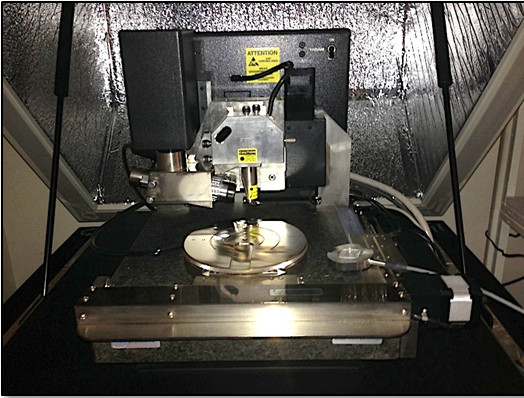
Device description:
The AFM (Dimension 3100, Bruker), allows to map the topography of a sample surface, together with some of its physical and/or mechanical properties, with fields of view ranging from 90 µm to a few tenths of nanometers.
Several modes are available: tapping, contact, EFM and MFM.
Accessories: cell for experiments in liquid, backlit sample holder for thin layer of standard thickness, vibration-free box.
Principle:
Atomic force microscopes consist of a sharp tip fixed under a micron-sized cantilever; the instrument works by measuring the deflection of the cantilever as it scans across the surface of a the specimen, not only resulting in maps of surface topography, but also giving insight into some of its physical and mechanical properties.
-
Contact Mode. The tip stays in contact with the sample when scanning, the vertical deflection is kept constant so that the z displacement of the cantilever provides a direct image of the topography of the sample surface (whereas the horizontal deflection gives insight on friction force between the tip and the sample). This mode also allows to perform punctual approach-retract curves, providing local characterizations of sample mechanical properties (inelastic and elastic deformations, adhesion force between the tip and the surface, etc…). Its main drawback lies in the fast degradation of fragile samples and tips, and the resulting artifacts.
-
Tapping Mode. The tip is oscillating at the cantilever’s resonance frequency, and the contact with the surface is only intermittent. The surface topography is therefore imaged with minimal damages. Furthermore, the phase-lag (error signal) provides images, the contrast of which can be interpreted as a variation of surface viscoelasticity.
-
MFM Mode. The magnetized tip is oscillating at the cantilever’s resonance frequency and scans at a fixed altitude (non-contact mode) the surface of a magnetic sample. The frequencies modulations caused by the surface/tip magnetic interactions allow to map local magnetic fields variations.
Lateral resolution: depends on the nature of the sample and type/curve radius of the tip.
Contacts:
Julius NOUET – 01 69 15 61 21 – This email address is being protected from spambots. You need JavaScript enabled to view it. (responsable scientifique et technique)