


Isotopic (δ13C) and elementary (C, N) analysis of the organic matter
Mass spectrometer IRMS ThermoFinnigan Delta Plus XP connected to an elemental analyzer Flash EA 1112 series


Flash EA 1112 Series Delta Plus XP
Characteristics of Instrumentation:
Isotope Ratio Mass Spectrometer (IRMS) Delta Plus XP (ThermoFinnigan), installed at LSCE in 2001, coupled to an Elemental Analyzer Flash EA 1112 Series installed in 2008. This spectrometer is a Continuous Flow type spectrometer. It is dedicated to the analysis of organic matter contained in different types of samples (sediments, bones, tissues, particles in suspension, etc.). The measurement accuracy of carbon isotopes is about 0.05 ‰. The amount of carbon required for a measurement is from 20 to 40 μg for isotopic measurements and an amount of 10 to 15 mg of samples is required for elemental analysis.
Principle of Measurement:
http://en.wikipedia.org/wiki/Isotope-ratio_mass_spectrometry
Measurements performed by instrumentation:
Carbon and nitrogen elementary quantification and carbon isotope (δ13C) analysis of organic matter. Developing in progress of isotopic measurements of nitrogen.
Contacts:
Caroline Gauthier : This email address is being protected from spambots. You need JavaScript enabled to view it.
Christine Hatté : This email address is being protected from spambots. You need JavaScript enabled to view it.
Jérémy Jacob : This email address is being protected from spambots. You need JavaScript enabled to view it.
FTIR microspectroscopy
Frontier spectrometer coupled to a Spotlight 400 imager (Perkin-Elmer)
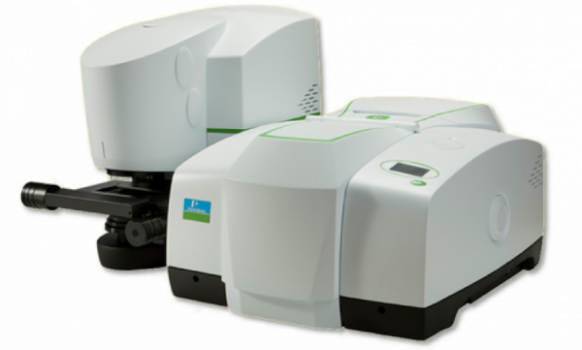
Principe of analysis
FT-IR microspectroscopy allows non-invasive determination of the composition of a sample, in solid, liquid or gaseous phase.
The technique is based on the identification of vibrational frequencies of chemical bonds. In molecules, the various bonds vibrate at specific frequencies, which are a function of the atoms making up the bonds, and their surrounding environment.
Each bond has several vibratory modes (symmetrical stretching, anti-symmetrical stretching, shearing, agitation, etc.): at given frequencies, the bond will therefore enter into resonance, absorbing a large part of the energy provided by the infrared beam.
Each peak in the FTIR absorption spectrum is therefore characteristic of the vibratory mode of a particular type of bond. Simple or even complex molecular assemblies can thus be identified from their spectral signatures. In some cases, structural information can even be provided.
The platform is equipped with a Frontier Spectrometer, coupled to a Spotlight 400 Imager (Perkin-Elmer).
Spotlight 400 imager
This microscope is equipped with a multi-pixel MCT detector in imaging mode (spectral range: 4000 to 700 cm-1) and a single-pixel MCT detector in spot mode (spectral range: 4000 to 550 cm-1). It enables fast, non-invasive, resolved hyperspectral mapping of solid samples.
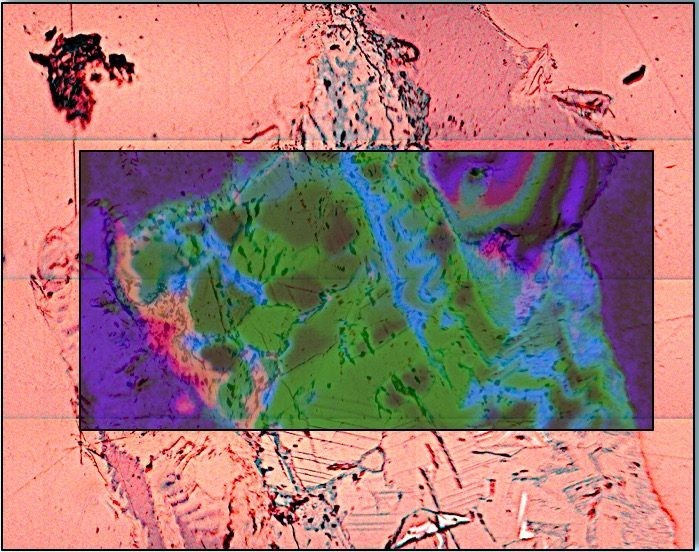
Hyperspectral mapping of a concretion with several carbonate phases (green: calcite; blue: magnesian calcite; red: magnesite)
Several accessories are available
-
Transmission mode: 6.25 µm resolution, thin samples (10-15 µm)
-
Reflection mode: 6.25 µm resolution, polished surfaces
-
ATR imaging mode (Germanium): resolution 1.56 µm, maximum field 500×500 µm
Frontier spectrometer
Several accessories are available for powder analysis:
-
Transmission module for K/Br pellets
-
DRIFT module (diffuse reflection)
-
ATR diamond module.
The ATR module, in particular, allows non-destructive characterization on small quantities, without any specific preparation. It is ideally suited to large sample series.
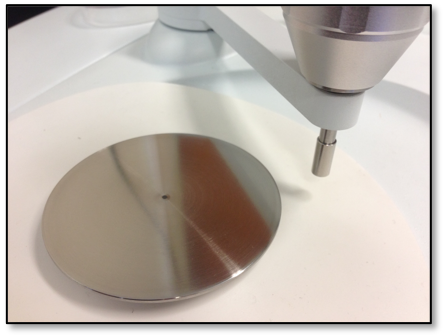
ATR module (Diamont) for powders analysis.
User chart
By using this instrument, the user undertakes to respect the general principles of fair use/re-use of data (ERIC DARIAH Data Re-use Charter). Intellectual property rights to results obtained on samples entrusted to the platform by an academic organization, and not involving any inventive activity on its part, remain with that organization. Users must adhere to the terms of DARIAH, in particular:
- A single citation format for the use of data (article, book or symposium/conference), which may only be used with the explicit agreement of all participants in the work, and must include an exhaustive list of authors.
- The data produced will be made available to the scientific community, if they have not been used after 5 years.
Funding
This instrument has been co-financed by the Ile-de-France Region as part of the "Natural Heritage" major area of interest (DIM MAP)
Contacts
Julius NOUET – 01 69 15 61 21 – This email address is being protected from spambots. You need JavaScript enabled to view it.
Amélie PLAUTRE – 01 69 15 61 27 – This email address is being protected from spambots. You need JavaScript enabled to view it.