


Detection and quantification of molecular biomarkers
Gaz chromatograph with flame ionisation detector (Agilent technologies, 6890N) equipped with an Automatic sampler, 100 positions (Agilent technologies, 7683B)
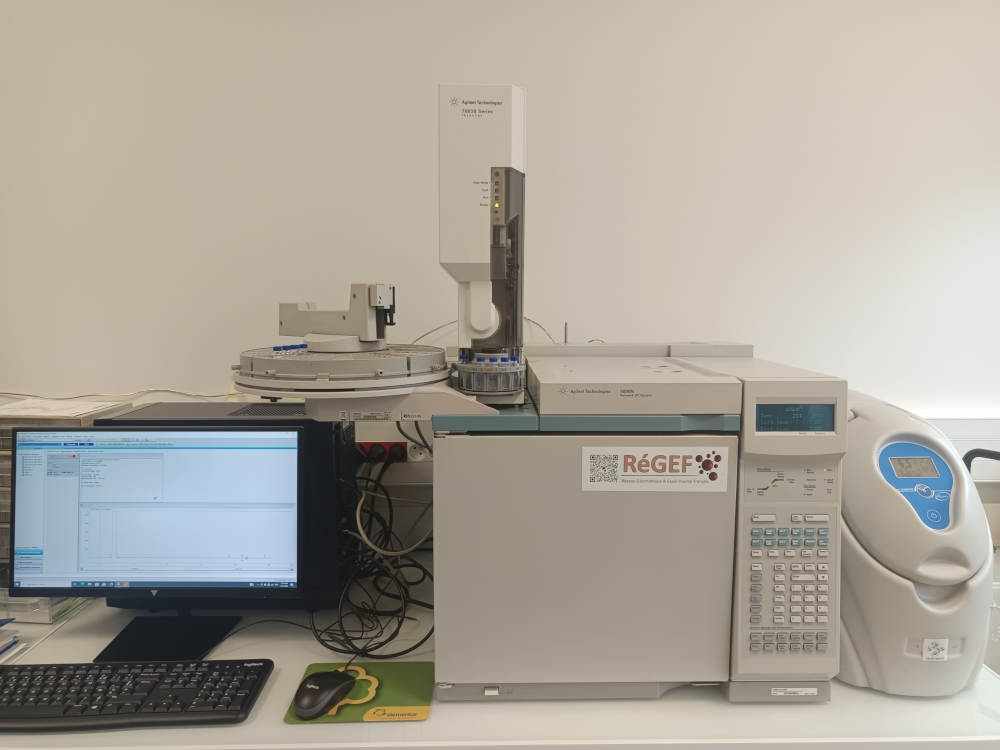
Instrument description:
Gaz chromatograph with flame ionisation detector (Agilent technologies, 6890N) with H2 as vector gaz
Automatic sampler, 100 positions (Agilent technologies, 7683B)
Principle of analysis:
GC-FID enables screening and quantification of lipids from a variety of archaeological and environmental matrices. It can be used to identify samples samples requiring further molecular analysis, such as structural structural analysis by GC-MS (mass spectrometry), isotopic analysis by GC-IRMS (isotope ratio mass spectrometry) on δ13C and δ2H and to adapt concentrations to instrument capacity, thus making it possible to extend the life of consumables. It can also be used to quantify isolation efficiencies of GC-preparative in developments targeting new compounds for 14C measurement by AMS (accelerator mass spectrometry) at the molecular level.
Analyses performed on the instrument :
Screening of total lipid extracts, quantification of biomarkers.
Contacts:
Caroline Gauthier : This email address is being protected from spambots. You need JavaScript enabled to view it.
Emmanuelle Casanova : This email address is being protected from spambots. You need JavaScript enabled to view it.
Funding:
Identification and quantification of molecular biomarkers
Gas chromatograph (Trace 1300) equipped with an autosampler (AS 3000) and coupled to a single quadrupole mass spectrometer (ISQ QD)
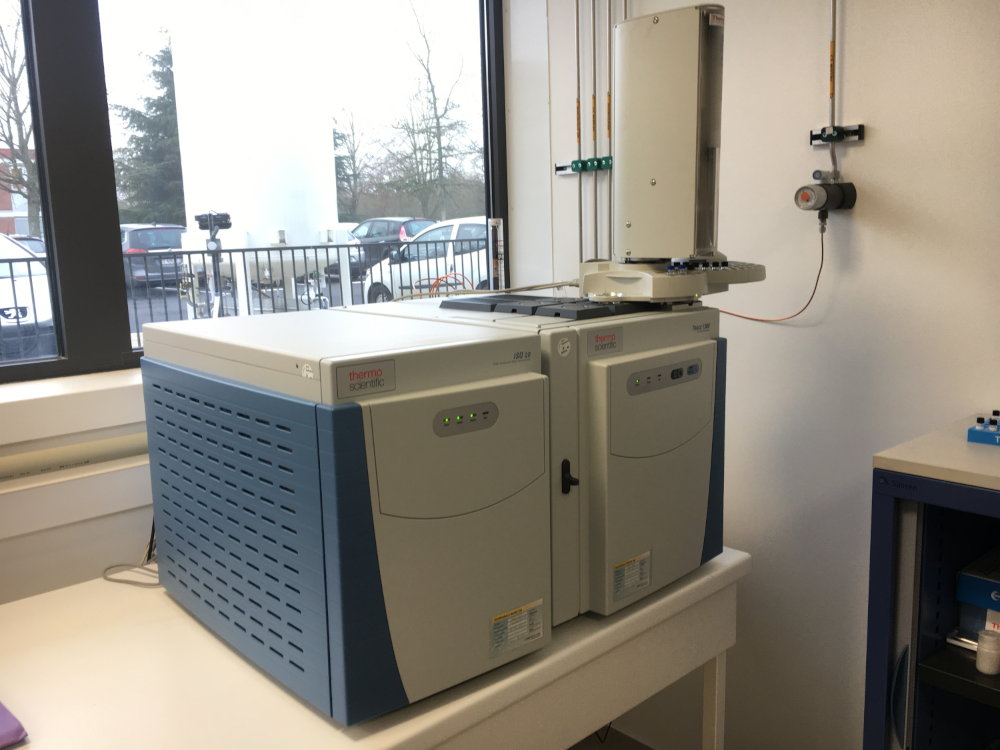
Instrument description:
Autosampler (AS 3000): The autosampler uses a syringe to withdraw a few µL of the fraction in solution in an organic solvent, and introduces it into the gas chromatograph injector. It has 105 positions for holding flasks, giving it a high degree of autonomy.
Gas chromatograph (Trace 1300): When the solution is introduced into the injector, the molecular biomarkers are focused at the head of the capillary column by the cold spot effect, the injector temperature being set at 280°C, whereas the chromatograph oven is at 50 or 80°C at the start of analysis. Molecular biomarkers are progressively separated in the capillary column under helium flow, as the temperature of the chromatography oven rises (usually to 300°C), according to their molecular weight and polarity.
Mass spectrometer (ISQ QD): When molecular biomarkers reach the end of the column in the mass spectrometer, they are ionized and fragmented by electron impact. The mass spectrometer determines the mass and abundance of each fragment.
Analyses performed on the instrument:
The results obtained are in the form of a chromatogram reflecting the evolution of the abundance of molecular fragments during the analysis and, for each analysis point, a mass spectrum corresponding to the abundance of fragments of different masses, a veritable biomarker identity card. All that remains is to quantify each biomarker, identify it using databases or the literature, and then determine its origin and significance.
Contacts:
Caroline Gauthier : This email address is being protected from spambots. You need JavaScript enabled to view it.
Emmanuelle Casanova : This email address is being protected from spambots. You need JavaScript enabled to view it.
Jérémy Jacob : This email address is being protected from spambots. You need JavaScript enabled to view it.